
How Studying PRINCE2 Is Helping Me Deliver Better Website Projects
I have been fortunate enough to study for a PRINCE2 qualification while working for Thames Systems. What surprised me most is how closely it connects with the way I have learned to approach website projects over the years.
I have always enjoyed the process of building websites — not just making something look good, but trying to understand what the client really needs. Often, clients know what they want the website to do, but they do not always know what they need to get there.
That is where the real work begins.
For years, I found myself doing a lot of mental gymnastics: asking questions, interpreting feedback, moving between ideas, revisiting earlier decisions, and trying to shape everything into a useful final website. After more than a decade of doing this work, I had already learned that web projects are best delivered in clear stages.
PRINCE2 has helped me understand what that staged approach can look like in a more structured, professional way.
The biggest lesson: start with the product
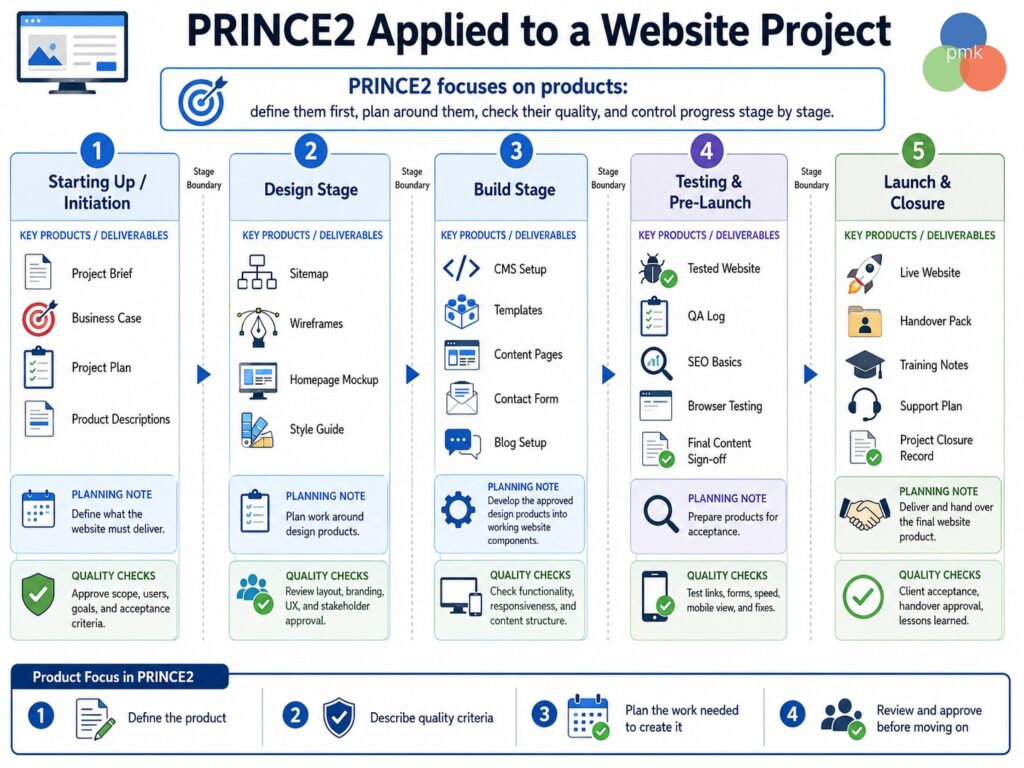
One of the most useful PRINCE2 ideas for web design is its focus on products.
In a website project, the “product” is not just the finished website. It includes all the things needed to get there: the project brief, sitemap, wireframes, content pages, design mockups, CMS setup, testing notes, handover documents, and the final live website.
This changes the conversation.
Instead of starting with “What should the website look like?”, we can start with better questions:
- What does the website need to achieve?
- Who is it for?
- What content does it need?
- How will we know it is successful?
- What needs to be approved before we move forward?
That makes the project clearer for both the designer and the client.
1. Starting up: define the website properly
The first stage is about understanding the project before rushing into design.
For a website, this means creating a clear project brief, business case, plan, and product descriptions. In simple terms, we define what the website must deliver and why it matters.
This is where I would look at the client’s goals, users, services, content needs, competitors, budget, timescales, and approval process. It is also where expectations need to be made clear.
A good website project should not begin with guesswork. It should begin with agreement.
2. Design stage: plan the experience before building it
The design stage is where the website starts to take shape.
This includes products such as the sitemap, wireframes, homepage mockup, and style guide. These are not just design assets. They are decision-making tools.
A sitemap helps confirm the structure. Wireframes help focus on content and user journeys before visual design gets in the way. Mockups show the look and feel. A style guide helps keep the website consistent.
This stage is also where UX thinking becomes essential. The goal is not to impress the client with decoration. The goal is to create a website that users can understand, navigate, and act on.
Before moving forward, the design should be reviewed against clear quality criteria: layout, branding, accessibility, usability, content clarity, and stakeholder approval.
3. Build stage: turn approved designs into working components
Once the design products are approved, the build stage becomes much easier to manage.
This is where the CMS setup, templates, content pages, contact forms, blog, and other working parts are created. PRINCE2 helps because the build is based on already agreed products, not loose ideas.
That does not mean nothing changes. Website projects always involve learning as you go. But changes are easier to handle when there is a clear plan, clear ownership, and clear stage boundaries.
The build stage should focus on functionality, responsiveness, content structure, and making sure the website works properly across real use cases.
4. Testing and pre-launch: prepare the website for acceptance
Testing is not just a final technical task. It is a quality stage.
For web design, this includes testing links, forms, page speed, mobile views, browser performance, SEO basics, and content accuracy. It also includes making sure the client has reviewed and signed off the final content.
This stage is where a website moves from “built” to “ready”.
It is also where PRINCE2 thinking is especially helpful. The question becomes: does this product meet the agreed acceptance criteria?
That keeps feedback focused and prevents the project from becoming an endless cycle of opinions.
5. Launch and closure: deliver the website properly
A successful website project does not end the moment the site goes live.
There should be a proper handover. This might include training notes, login details, a support plan, a handover pack, and a project closure record.
This final stage helps the client feel confident using the website. It also creates space to review what went well, what could be improved, and what might be needed next.
For me, this is one of the most valuable parts of applying PRINCE2 to web design. It turns launch from a rushed finish line into a controlled handover.
Why this approach works better
PRINCE2 has helped me put structure around something I had already started to understand through experience: websites need stages, not chaos.
A strong web design process should define the product first, describe what quality looks like, plan the work needed to create it, review it properly, and only then move on.
That approach helps reduce confusion. It gives clients more confidence. It helps designers avoid unnecessary rework. Most importantly, it keeps the project focused on delivering a website that actually works for the people who need to use it.
Studying PRINCE2 has not made web design feel more corporate or complicated. It has made the process feel clearer.
And for clients, clarity is one of the most valuable things a designer can offer.

Leave a Reply